

"ABM data" improved the number of participants in our company's seminars and the number of sales toss-ups
KDDI Corporation
Solution Business Headquarters Solution Business Planning Headquarters Marketing Department Channel Marketing Group Group Leader
Mr. Kenji Tobe
Solution Business Headquarters Solution Business Planning Headquarters Marketing Department Channel Marketing Group Group Leader
Mr. Kenji Tobe
記事公開日:2022年12月19日
It's a waste just to put the seminar list in MA. KDDI, a major telecommunications carrier, co-sponsored the ITmedia Inc."Security Week 2022 Spring" hosted by ITmedia held in March 2022 and obtained a large number of seminar lists. However, about 90% of them were "other companies' lecture lists" that watched sessions other than our own lectures, so when we followed up based on "ABM data", participants in our own seminars and toss-ups to sales increased. It is said that We will introduce what "ABM data" is and the specific method of follow-up that KDDI has done.
| Introduction of background and issues | Effective use of the list of lectures by other companies and specific follow-up measures |
|---|---|
| Implementation details | ABM data |
| Effect of use | Increase in participants in in-house seminars and sales toss-ups |
● Unfortunate use of the “seminar list”
In recent years, due to the covid-19 disaster, online seminars are booming. The participants have become accustomed to online events, and from the organizer's point of view, a relatively large number of participants have gathered. However, it seems that the response from the side that utilizes the participant list (seminar list) has not changed from before.
When we asked customers who sponsored a ITmedia Inc. sponsored by ITmedia about how to use the list, they answered: 1. "Comprehensive acknowledgment type" to listen to the needs of those who participated in the company's session as a thank you, 2. Company name and occupation, It seems that it falls under either the "pickup type" that picks up and follows only those who are interested in looking at the contents of the questionnaire, or the "idle type" that does not follow up after entering 3.MA or SFA.
If you call a list of people who have participated in your company's sessions or who have responded to questionnaires, the reasons are clear and it is easy to follow up. In the case of co-sponsored webinars, the list includes people who are watching other than the company's lectures, so the list that can be approached is small, and there are many cases where the majority is left to the nurturing process. Uka I don't deny nurturing, but I think it's a bit of a disappointing usage.
● What are some things that are "okay to have, but not very useful"?
So, how many people on the list of collective webinars sponsored by multiple companies watch anything other than their own talks?
Here is the breakdown of the list of ITmedia-sponsored collective ITmedia Inc."Security Week 2022 Spring" that KDDI actually obtained. The blue parts are those who applied for KDDI lectures, and the red parts are those who applied for lectures by sponsoring companies other than KDDI. About 90% of the total applicants for presentations were from other companies, as we were a sponsor of the Platinum Plan (providing a list of participants for all sessions). The list of other companies' lectures contains only personal information, and details such as which lectures you applied for, whether you actually participated in, whether you responded to a questionnaire, and what your responses were like are not known. It looks like
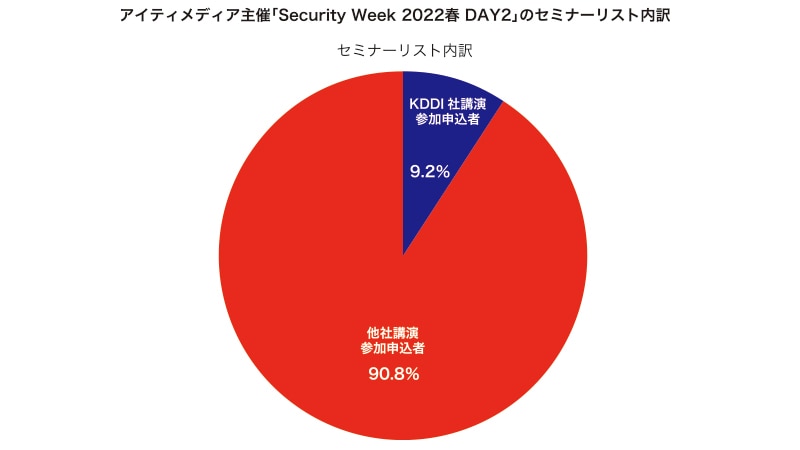
Although some target leads are included in the "other company's lecture list," it is not clear how to contact them, and as a result, they may not be individually followed up on, but instead captured by MA or other means.
● Reasons why a company's "field of interest" is a clue when approaching the "list of other companies' presentations"
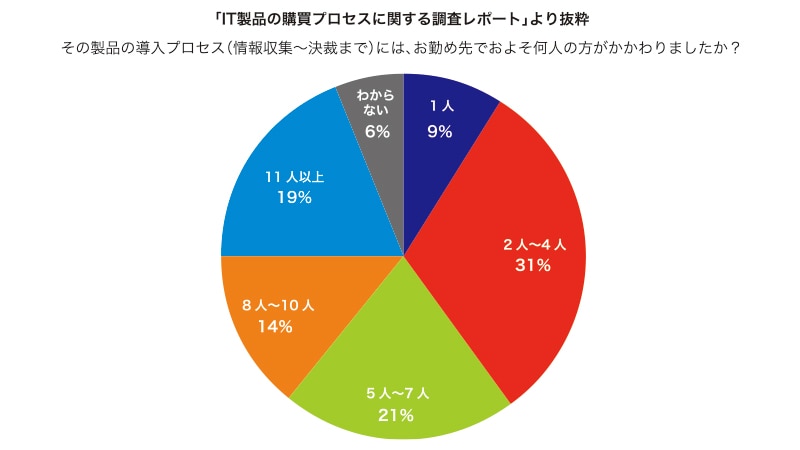
According to research by ITmedia Inc., the average number of people involved in the introduction of IT products was 6.3 (*) . This tends to increase as the product spreads across IT infrastructure and departments. Considering that those who attend seminars to gather information play a role in the activities of companies considering the introduction of IT products, it is natural to assume that the interests of seminar attendees overlap with those of the organizations and companies to which they belong.
*From "Survey Report on IT Product Purchasing Process". Survey planning: ITmedia Inc. Inc. Survey implementation: Macromill Co., Ltd. Conducted in December 2020 N = 325
ITmedia accumulates the behavior histories of members with more than 1.1 million cumulative registrants on a daily basis through ITmedia Inc. Japan, Keyman's Net, etc., and provides marketing support services that utilize this data. One of them, "ABM data", aggregates the behavior history for each company to which it belongs--for example, aggregates what kind of information gathering activities are being carried out on a specific theme such as "zero trust"-- - We provide information that visualizes the degree of interest for each company.
The data used in "ABM Data" is from ITmedia Inc.'s "ABM Report". Create a segment (like a cluster of areas of interest) that matches the theme of the webinar and an "ABM report" with the company to which the applicant belongs, and link the applicant's personal information sheet with the company name. (For a detailed explanation of the "ABM Report", please refer to this page)
Since a company's areas of interest are based on the individual's behavioral history, this allows us to know what the company is interested in and which of the "under consideration" flags are lit, even if it is a "list of lectures by other companies.
● KDDI's method of utilizing "ABM data"

"By using ABM data, it became easier to anticipate responses before making calls."
KDDI CORPORATION Solution Business Headquarters Solution Business Planning Headquarters Marketing Department Channel Marketing Group
Chino Hayashi
How did KDDI use the "ABM data" in the follow-up call to the "list of presentations by other companies"?
According to Ms. Hayashi, who is in charge of inside sales at KDDI, the purpose of calling the "list of other companies' lectures" is to "entice" them to seminars held by their company. At KDDI, we assume that the viewers included in the list of lectures from other companies, which is the entrance to the nurturing funnel, are at a stage where they do not know about our company's products and services, and the next stage is viewing our company's seminars. . Participating in the company's seminar advances understanding, and it is said that it is easier to make a project after that. On the other hand, the call to the "company lecture list" is in the form of thanking you for participating and asking for your requests and opinions, so we will design it with attention to the different stages of the nurturing funnel.
Let's take a look at the specific steps.
Step 1: Narrowing down the target of the call Since the purpose of inside sales is to create new projects, we will exclude target people who belong to companies such as competitors, IT product vendors, and companies currently in negotiations.
Step 2: Extract those whose company's products appear in the "area of interest" of "ABM data"
Among the first to third places of interest listed in the ABM data, we will extract the target people who include fields that match our company's products. How many matches you can get here is very important. The base "ABM report" must include "fields" related to the products handled by the company.
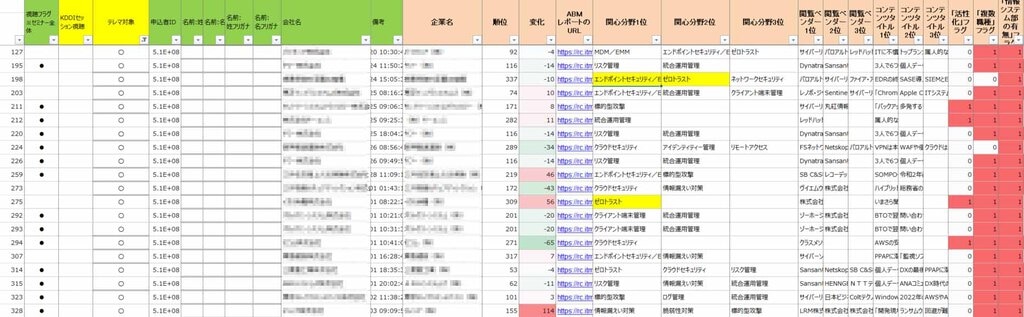
A call list that matches the "other company's lecture list" by field of interest
Step 3: Confirm the "Area of Interest" of "ABM Data" before calling
The last is the procedure for follow-calls. In addition to the positional information such as department name and job title, the list of lectures by other companies is given the company's "fields of interest" based on "ABM data". Using that as a reference, we assembled an envisioned talk story and made the call. After confirming that the person was in charge of security, we picked up topics from the previous "areas of interest" to find out what the issues were, and whether they would be willing to participate in our company's seminars or business negotiations. Check for the presence of
Regarding actual conversations, there are multiple "areas of interest" in security, and the skills of operators are not uniform, so it is better to allocate leads according to the areas of interest and the skills of each operator rather than putting them into a fixed script. ' advises Mr. Tobe of KDDI.
● Things that can be seen from the call results
When we asked those who were able to make a call and connect with a security staff member if they were personally interested in the company's "areas of interest," nearly half of the respondents said that the company's and individual's areas of interest matched. Got results. I learned that if you use the fields of interest in a company well, it will be easier to connect with people who are interested in your company's products. As a result, in addition to following up on the viewers of KDDI's lectures, the "list of other company's lectures" also led to invitations to our company's seminars and the creation of business negotiations. Toss-up rate” improved as a result.
In addition, although it is a qualitative impression, from the operator, "By narrowing down the interests of the person or company to some extent with the 'area of interest' of 'ABM data', it is possible to simulate preparations before calling and response. I received a comment that it became easier. We have received feedback from the call site that it would be helpful if there was even a little hint of information for the talk, and we can also expect it to provide psychological support.
●What is "other information" that KDDI wants to use?
This time, KDDI used "ABM data" to match the information of "1st to 3rd place in the field of interest" with our own products, but there are various other information. For example, the "change" of the ranking.
The ABM Report uses a unique scoring model to rank the degree of interest of companies relative to each other, and large companies that collect information on a regular basis tend to rank high. Therefore, if we look at the difference from the previous month's ranking in terms of "changes," we can see that the big movement actually indicates that the company has started considering introducing it, and it plays the role of catching the timing to efficiently find customers who want to listen to it. Plays. In particular, there are reports that it is easier to get business negotiation opportunities if you follow "newly emerging" companies.
"Introduction consideration related flag" is also effective. In addition to the flag "Scheduled to be introduced within 1 year" flag, if the flags such as "Existence of management / corporate planning department", "Existence of manager or higher", "Presence of budget" are lit, it means that the actual There is a strong tendency to increase the probability that there will be a project under consideration for introduction, and it can be effectively used as a guideline for project discovery.
In addition, Ms. Hayashi said, "We could have used the list more effectively if we had properly targeted and approached each company using flags related to considering introduction." For example, we narrowed down the target by "area of interest" and used it to attract customers to related seminars by e-mail magazine, etc., and expanded the image of data utilization.
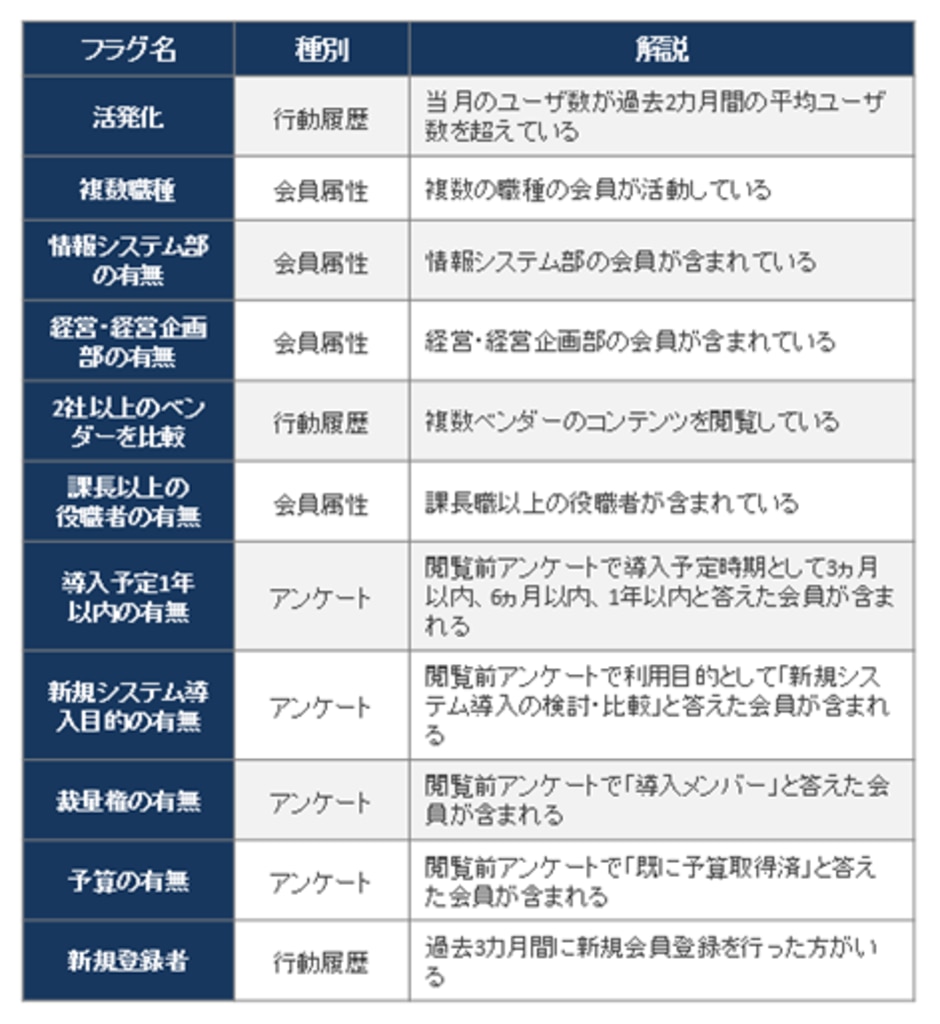
"Introduction consideration related flag" provided by "ABM data"
*The posted information is as of January 2023.
■ About KDDI Corporation

KDDI collaborates with KDDI Group companies with various specialties to promote work style reforms, productivity improvement and automation of work "Corporate DX", and "Business DX" to solve management and social issues with the power of digital technology. In addition, we support the creation of new businesses and operational reforms that will be required in the coming era by providing “business infrastructure services” such as data centers and contact centers that are necessary to facilitate these activities.
■ About ABM data
ITmedia's "ABM data" is a data product that extracts and provides the necessary parts from "ABM reports" created based on the behavior history of readers at TechTarget Japan / Keyman's Net / ITmedia Inc./ TechFactory. By linking personal information such as seminar lists and MA (marketing automation), it is possible to understand where companies and organizations are interested, what vendors they are contacting, vendor content they have read, and "introductory information." It can be used to determine the priority of approach according to "examination related flag" and to expose the sense of issue.
For more information about the ABM Report, please visit this page
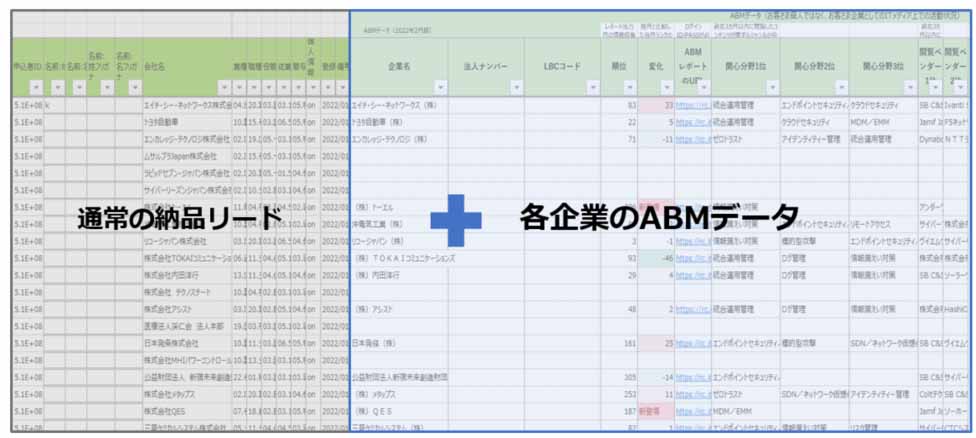
Delivery image of linking “seminar list” and “ABM data”

CONTACT
Materials for the ABM report
Inquire about services
See the promotion casebook

〒102-0094
3-12 Kioicho, Chiyoda-ku, Tokyo
(Reception 13th floor)
3-12 Kioicho, Chiyoda-ku, Tokyo
(Reception 13th floor)


(C) Copyright ITmedia Inc. All rights reserved.